
ÖNEN / ARTIFICIAL INTELLIGENCE AND CLINICAL DECISION SUPPORT
From our clinical experience
AI born from this experience.
The AI-supported pediatric urology project founded and led by principal investigator Prof. Dr. Abdurrahman Önen considers assessment, treatment planning and long-term follow-up together.2012 — this development initiative began with the aim of bringing structured clinical information together with medical experience.
Explore our project's approach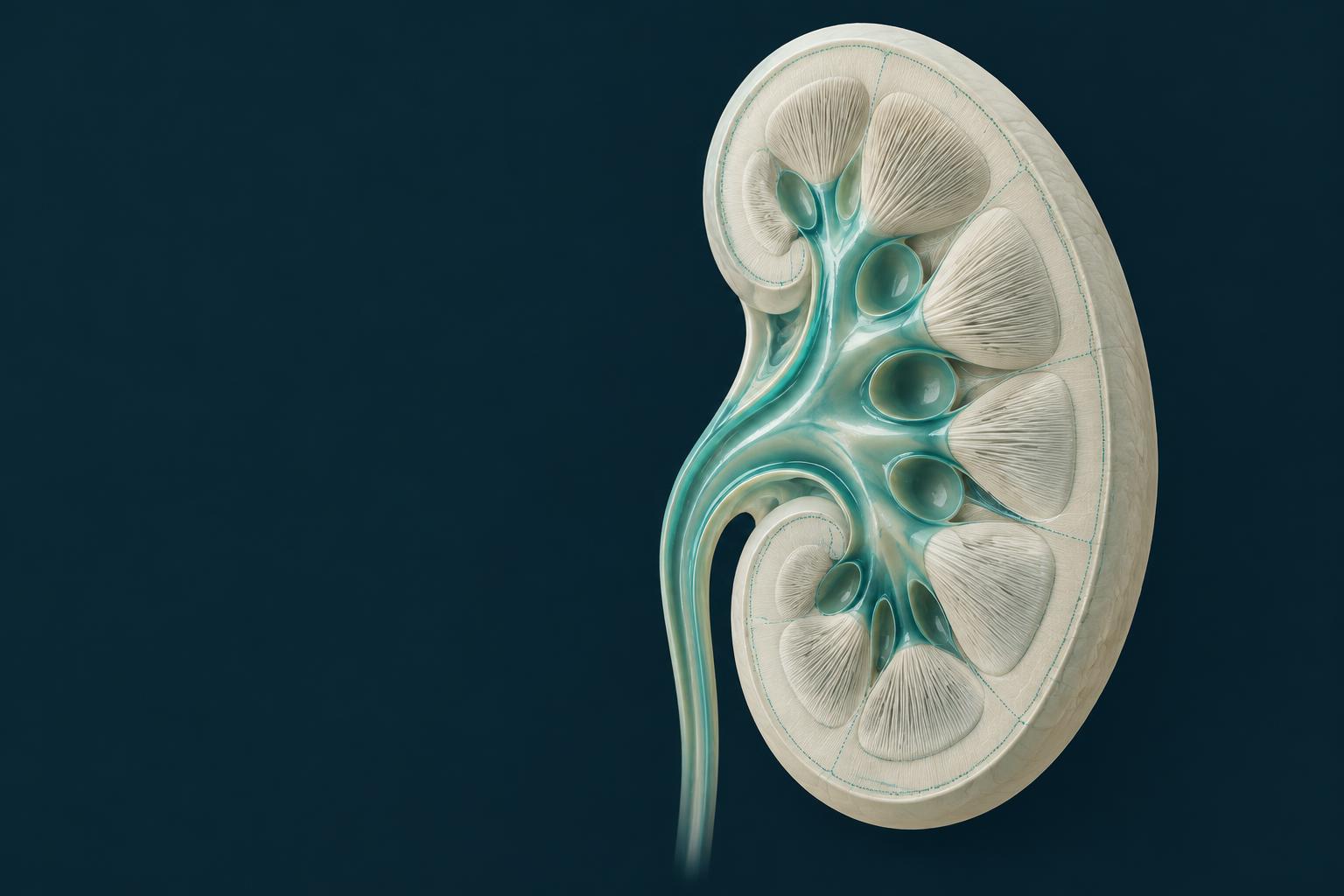
01
Assessment
02
Treatment planning
03
Long-term follow-up
PROF. DR. ABDURRAHMAN ÖNEN / FOUNDER AND PRINCIPAL INVESTIGATOR
Our own project, a comprehensive approach.
In pediatric urology, every piece of information gains meaning in the context of a child's history and changes over time. Our project aims to combine clinical biostatistics and long-term follow-up data with AI methods to develop an electronic system supporting medical assessment.
01
Assessment
Considering structured clinical information together in a way that supports physician assessment.
02
Treatment planning
Organizing clinical data and follow-up information in a way that may contribute to treatment planning.
03
Long-term follow-up
Development work aimed at examining accumulated measurements and outcomes together over time.
The project ownership, leadership role and development scope are based on the project record in the CV. In the professional information update of 19 October 2026, the starting year is 2012 as stated. It makes no claim of clinical performance or regulatory approval.
Our development approach.
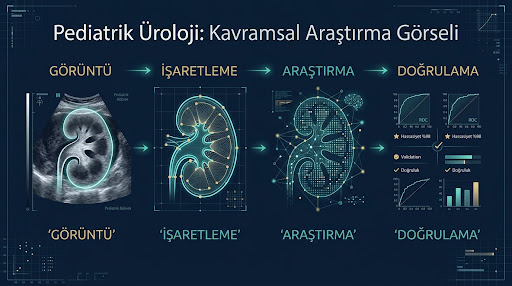
In this work, which moves from clinical experience to structured information and from information to research and assessment, we address physician oversight and data privacy together. The visuals explain the development approach; they do not show actual patient investigations or validated model results.
Educational resources for physicians and studentsOUR PROJECT'S DEVELOPMENT APPROACHClinical information · Research · Physician oversight
EXPLORE RELATED SCIENTIFIC LITERATURE
Related scientific literature.
Selected publications for readers wishing to explore the field's research context. These studies are separate sources from our own project record.
FROM EXTERNAL LITERATURE / 01
From ultrasound to measurement
Deep learning methods are being studied to standardize measurements by separating the kidney boundaries and dilated collecting system on ultrasound images.
2021 · Feasibility research
An example from the literature
Read the research source Evaluation of pediatric hydronephrosis using deep learning quantification of fluid-to-kidney-area ratio by ultrasonography
Lin et al. · Abdominal Radiology · 2021
DOI: 10.1007/s00261-021-03201-w
- Input
- The kidneys and dilated collecting system areas in children's ultrasound images.
- Research objective
- Segmentation of kidney and fluid areas; measurement of the fluid-to-kidney area ratio.
- Verification
- A feasibility study; the accessible abstract does not describe the sample size or external validation.
Limitation: This feasibility study does not establish widespread clinical use or the performance of a model on this website.
Source check: 2026-10-14FROM EXTERNAL LITERATURE / 02
Modeling risk and change
Models combining ultrasound measurements with age and other clinical information are being studied to assess obstruction risk in hydronephrosis. Modeling change over time is a research goal that requires additional validation using follow-up data.
2024 · Development and external validation at two institutions
An example from the literature
Read the research source Predicting obstruction risk using common ultrasonography parameters in paediatric hydronephrosis with machine learning
Khondker et al. · BJU International · 2024
DOI: 10.1111/bju.16159
- Input
- Age and ultrasound measurements; findings from the same assessment period, such as AP diameter and SFU grade.
- Research objective
- Risk categories defined according to drainage time on diuretic renography.
- Verification
- Development/internal validation in 304 children; external validation in 64 children from another institution.
Limitation: The highest-risk category is absent from the external sample. Serial ultrasound inputs were not used; this is not prospective evidence of kidney loss or the need for surgery.
Source check: 2026-10-14FROM EXTERNAL LITERATURE / 03
Patterns in voiding flow
Patterns are being studied by considering uroflowmetry measurements, post-void residual urine and pelvic floor findings together. The performance of models across different ages, devices and centers needs to be demonstrated.
2026 · Single-center retrospective study
An example from the literature
Read the research source Prediction of pediatric lower urinary tract dysfunction using uroflowmetry data and machine learning with explainable AI techniques
Dinçel et al. · International Urology and Nephrology · 2026
DOI: 10.1007/s11255-026-05342-7
- Input
- Combined use of uroflowmetry measurements and clinician-coded information on bladder capacity, voiding patterns and pelvic floor activity.
- Research objective
- Modeling lower urinary tract dysfunction categories assigned by clinicians.
- Verification
- 2,663 records; single-center retrospective study with an internal training/test split and cross-validation.
Limitation: Some inputs and target categories rely on the same clinical judgments; independent automated diagnostic capability has not been demonstrated. Multicenter external validation is needed, and the findings cannot be generalized to invasive urodynamic pressure signals.
Source check: 2026-10-14FROM EXTERNAL LITERATURE / 04
From report to research data
Natural language processing is being studied to convert findings in ultrasound reports into common data fields. The accuracy of the structured information is assessed through human review.
2024 · Preprint
An example from the literature · Preprint
Read the research source High-performing Multi-task Model of Urinary Tract Dilation (UTD) Classification for Neonatal Ultrasound Reports Through Natural Language Processing
Hua et al. · medRxiv · 2024
DOI: 10.1101/2024.01.23.24301680
- Input
- The text of early postnatal ultrasound reports; specialist review of reports/images to establish reference categories.
- Research objective
- Extraction of UTD components and classifications from report text.
- Verification
- 2,460 reports; internal cross-validation. The version reviewed is the v1 preprint.
Limitation: This version is not presented as a peer-reviewed article. A current peer-reviewed version, external validation and real-time integration have not been verified.
Source check: 2026-10-1401 / Report ↓02 / Structured findings ↓03 / Human review ↓04 / Research dataset
From research to clinical use
A model's purpose, uncertainties and limitations should be clear. Independent validation, physician oversight and data privacy are considered together.
These literature examples are not evidence of approval or performance for Prof. Dr. Önen's development work. This section does not offer individual assessment, patient uploads or a diagnostic tool.
Scientific contributions
Önen Genital Injury Classification
Önen Bladder–Bowel Dysfunction Symptom Scale
Önen Pediatric Urinary Stone Algorithm
Önen Nephro-Uro Stent; CV patent record TR201709887B, 2021
An approach to artificial intelligence research and development in pediatric urology
TR201709887B, 2021: Nephro-Uro Stent patent record. A patent does not mean that the device is approved in every country or appropriate in every situation.
Related scientific publications